Reference Books
The best Data Science books, hand-picked for every level — from your first Python script to production ML systems.

Fluent Python: Clear, Concise, and Effective Programming
Luciano Ramalho
Don't waste time bending Python to fit patterns you've learned in other languages. Python's simplicity lets you become productive quickly, but often this means you aren't using everything the language has to offer. With the updated edition of this hands-on guide, you'll learn how to write effective, modern Python 3 code by leveraging its best ideas.
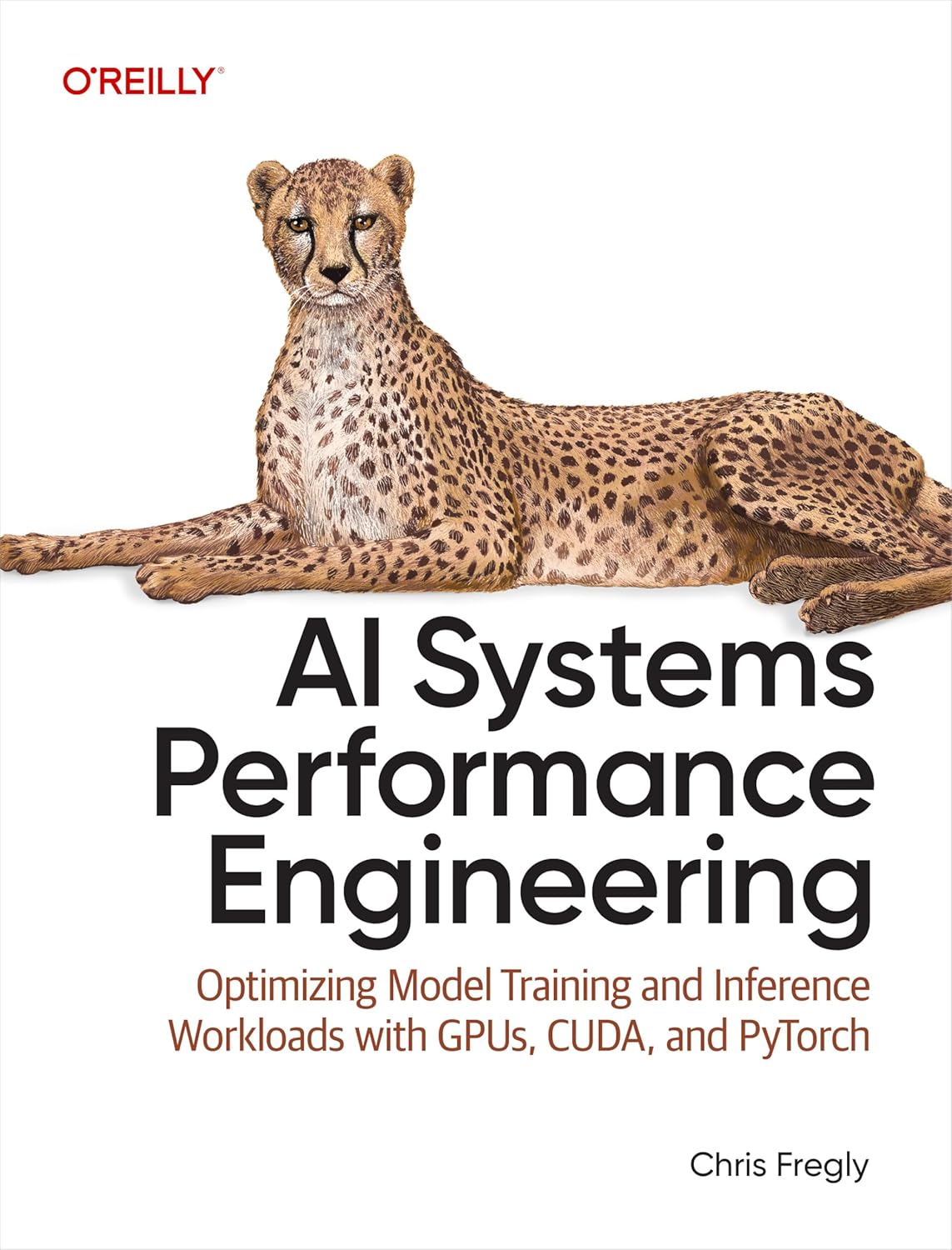
AI Systems Performance Engineering: Optimizing Model Training and Inference Workloads with Gpus, Cuda, and Pytorch
Chris Fregly
Elevate your AI system performance capabilities with this definitive guide to maximizing efficiency across every layer of your AI infrastructure. In today's era of ever-growing generative models, AI Systems Performance Engineering provides engineers, researchers, and developers with a hands-on set of actionable optimization strategies. Learn to co-optimize hardware, software, and algorithms to build resilient, scalable, and cost-effective AI systems that excel in both training and inference. Authored by Chris Fregly, a performance-focused engineering and product leader, this resource transforms complex AI systems into streamlined, high-impact AI solutions.
View details →
Hands-On Machine Learning with Scikit-Learn and PyTorch: Concepts, Tools, and Techniques to Build Intelligent Systems
Aurélien Géron
The potential of machine learning today is extraordinary, yet many aspiring developers and tech professionals find themselves daunted by its complexity. Whether you're looking to enhance your skill set and apply machine learning to real-world projects or are simply curious about how AI systems function, this book is your jumping-off place.

Hands-On Machine Learning with Scikit-Learn, Keras, and Tensorflow: Concepts, Tools, and Techniques to Build Intelligent Systems
Aurélien Géron
Through a recent series of breakthroughs, deep learning has boosted the entire field of machine learning. Now, even programmers who know close to nothing about this technology can use simple, efficient tools to implement programs capable of learning from data. This bestselling book uses concrete examples, minimal theory, and production-ready Python frameworks (Scikit-Learn, Keras, and TensorFlow) to help you gain an intuitive understanding of the concepts and tools for building intelligent systems.

Designing Machine Learning Systems: An Iterative Process for Production-Ready Applications
Chip Huyen
Machine learning systems are both complex and unique. Complex because they consist of many different components and involve many different stakeholders. Unique because they're data dependent, with data varying wildly from one use case to the next. In this book, you'll learn a holistic approach to designing ML systems that are reliable, scalable, maintainable, and adaptive to changing environments and business requirements.

Designing Data-Intensive Applications: The Big Ideas Behind Reliable, Scalable, and Maintainable Systems
Martin Kleppmann, Chris Riccomini
Data is at the center of many challenges in system design today. Difficult issues such as scalability, consistency, reliability, efficiency, and maintainability need to be resolved. In addition, there's an overwhelming variety of systems, including relational databases, NoSQL datastores, data warehouses, and data lakes. There are cloud services, on-premises services, and embedded databases. What are the right choices for your application? How do you make sense of all these buzzwords?

Learning Data Science: Data Wrangling, Exploration, Visualization, and Modeling with Python
Sam Lau, Joseph Gonzalez, Deborah Nolan
As an aspiring data scientist, you appreciate why organizations rely on data for important decisions—whether it's for companies designing websites, cities deciding how to improve services, or scientists discovering how to stop the spread of disease. And you want the skills required to distill a messy pile of data into actionable insights. We call this the data science lifecycle: the process of collecting, wrangling, analyzing, and drawing conclusions from data.

R for Data Science: Import, Tidy, Transform, Visualize, and Model Data
Hadley Wickham, Mine Cetinkaya-Rundel, Garrett Grolemund
Use R to turn data into insight, knowledge, and understanding. With this practical book, aspiring data scientists will learn how to do data science with R and RStudio, along with the tidyverseâ??a collection of R packages designed to work together to make data science fast, fluent, and fun. Even if you have no programming experience, this updated edition will have you doing data science quickly.

The Art of Statistics: How to Learn from Data
David Spiegelhalter
In this "important and comprehensive" (New Yorker) guide to statistical thinking, discover how you can use data and mathematics to gain a better understanding of life's biggest problems. The age of big data has made statistical literacy more important than ever. In The Art of Statistics, David Spiegelhalter shows how to apply statistical reasoning to real-world problems. Whether we're analyzing preventative medical screening or the terrible crime sprees of serial killers, Spiegelhalter teaches us how to clarify questions, assumptions, and expectations and, most importantly, how to interpret the answers we receive. Combining the incomparable insight of an expert with the playful enthusiasm of an aficionado, The Art of Statistics is the definitive guide to the power of data.

AI Engineering: Building Applications with Foundation Models
Chip Huyen
Recent breakthroughs in AI have not only increased demand for AI products, they've also lowered the barriers to entry for those who want to build AI products. The model-as-a-service approach has transformed AI from an esoteric discipline into a powerful development tool that anyone can use. Everyone, including those with minimal or no prior AI experience, can now leverage AI models to build applications. In this book, author Chip Huyen discusses AI engineering: the process of building applications with readily available foundation models.
View details →
Python Data Science Handbook: Essential Tools for Working with Data
Jake VanderPlas
Python is a first-class tool for many researchers, primarily because of its libraries for storing, manipulating, and gaining insight from data. Several resources exist for individual pieces of this data science stack, but only with the new edition of Python Data Science Handbook do you get them all—IPython, NumPy, pandas, Matplotlib, Scikit-Learn, and other related tools.

Ace the Data Science Interview: 201 Real Interview Questions Asked By FAANG, Tech Startups, & Wall Street
Nick Singh, Kevin Huo
Authored by two Ex-Facebook employees, Ace the Data Science Interview is the best way to prepare for Data Science, Data Analyst, and Machine Learning interviews, so that you can land your dream job at FAANG, tech startups, or Wall Street.

Python for Data Analysis: Data Wrangling with pandas, NumPy, and Jupyter
Wes McKinney
Get the definitive handbook for manipulating, processing, cleaning, and crunching datasets in Python. Updated for Python 3.10 and pandas 1.4, the third edition of this hands-on guide is packed with practical case studies that show you how to solve a broad set of data analysis problems effectively. You'll learn the latest versions of pandas, NumPy, and Jupyter in the process.

Becoming a Data Head: How to Think, Speak, and Understand Data Science, Statistics, and Machine Learning
Alex J. Gutman, Jordan Goldmeier
"Turn yourself into a Data Head. You'll become a more valuable employee and make your organization more successful." Thomas H. Davenport, Research Fellow, Author of Competing on Analytics, Big Data @ Work, and The AI Advantage

Practical Statistics for Data Scientists: 50+ Essential Concepts Using R and Python
Peter Bruce; Andrew Bruce, Peter Gedeck
Statistical methods are a key part of data science, yet few data scientists have formal statistical training. Courses and books on basic statistics rarely cover the topic from a data science perspective. The second edition of this popular guide adds comprehensive examples in Python, provides practical guidance on applying statistical methods to data science, tells you how to avoid their misuse, and gives you advice on what’s important and what’s not.

Data Science for Business: What You Need to Know about Data Mining and Data-Analytic Thinking
Foster Provost; Tom Fawcett
This broad, deep, but not-too-technical guide introduces you to the fundamental principles of data science and walks you through the "data-analytic thinking" necessary for extracting useful knowledge and business value from the data you collect.

Data Science (The MIT Press Essential Knowledge series)
John D. Kelleher; Brendan Tierney
A concise introduction to the emerging field of data science, explaining its evolution, relation to machine learning, current uses, data infrastructure issues, and ethical challenges.

Data Science For Dummies
Lillian Pierson
What if there was one simple, clear process for ensuring that all your company's data science projects achieve a high a return on investment? What if you could validate your ideas for future data science projects, and select the one idea that's most prime for achieving profitability while also moving your company closer to its business vision? There is.

Data Science from Scratch: First Principles with Python
Joel Grus
To really learn data science, you should not only master the tools―data science libraries, frameworks, modules, and toolkits―but also understand the ideas and principles underlying them. Updated for Python 3.6, this second edition of Data Science from Scratch shows you how these tools and algorithms work by implementing them from scratch.

Mastering Data Science: A Comprehensive Hands-on Guide
SK Singh
In the era of data-driven decision-making, Mastering Data Science: A Comprehensive Hands-On Guide serves as an essential resource for aspiring and experienced data scientists alike. Whether you're just getting started or looking to sharpen your skills, this book provides a structured, practical, and hands-on approach to mastering data science.

Essential Math for Data Science: Take Control of Your Data with Fundamental Linear Algebra, Probability, and Statistics
Thomas Nield
Master the math needed to excel in data science, machine learning, and statistics. In this book author Thomas Nield guides you through areas like calculus, probability, linear algebra, and statistics and how they apply to techniques like linear regression, logistic regression, and neural networks. Along the way you'll also gain practical insights into the state of data science and how to use those insights to maximize your career.