Field manuals
Quick Guides
Focused, no-fluff guides that take you from zero to confident data practitioner.

LlamaIndex Made Simple
Volume 27 — LlamaIndex presents a clear, practical, and strategically mature perspective on using LlamaIndex to connect language models to data, documents, and knowledge bases. Keeping the 10‑minutes‑per‑day learning approach, the book explains how to move from generic prompts to retrieval‑based applications, covering documents, nodes, indexes, retrievers, query engines, embeddings, vector databases, and RAG. Throughout the work, the reader understands how to ingest documents, organize information, retrieve relevant passages, generate grounded answers, and control risks such as outdated data, unauthorized access, prompt injection, and false completeness. More than a technical introduction, this volume shows that the true value of LlamaIndex lies in transforming scattered data into queryable, traceable, secure knowledge that is useful for real‑world decision‑making.
Read this guideMore Quick Guides

CrewAI Made Simple
by V. L. Muller
Volume 26 — CrewAI presents a practical, clear, and strategically mature perspective on using CrewAI to build teams of AI agents. Keeping the 10‑minutes‑per‑day learning approach, the book explains how to move from isolated agents to multi‑agent structures with roles, goals, tasks, tools, processes, and governance. Throughout the work, the reader understands CrewAI’s main building blocks—agents, tasks, crews, tools, and processes—and learns to design sequential, hierarchical, or collaborative flows for use cases in research, content, support, analysis, operations, and management. More than a technical guide, this volume shows that the true value of multi‑agent AI lies not in creating many agents, but in organizing work with clarity, clear limits, continuous evaluation, and operational responsibility.
Read guide
LangChain Made Simple
by V. L. Muller
In Volume 25 — LangChain, presents a clear, practical, and strategically mature view of LangChain, a framework that has become one of the main bridges between language models and real-world artificial intelligence applications. Maintaining the 10‑minutes‑a‑day learning approach, the book explains how to move from isolated prompts to systems with workflows, memory, tools, agents, RAG, observability, and governance. Throughout the work, the reader understands LangChain’s key components — LLMs, chains, agents, tools, prompt templates, retrievers, and integrations — and learns to assess when to use them, which risks to control, and how to avoid unnecessary complexity. More than a technical guide, this volume is an invitation to maturity in building AI applications: solutions connected to data and systems, yet designed with security, clarity, continuous evaluation, and operational responsibility.
Read guide
LAMs Made Simple
by V. L. Muller
Volume 24 — LAMs Made Simple presents a clear, practical, and strategically mature view of Large Action Models—action-oriented artificial intelligence models that represent a new stage of applied AI. With accessible language and conceptual depth, the book explains how LAMs differ from LLMs, AI agents, and traditional automations, showing that their main contribution lies in transforming human intention into digital execution across interfaces, systems, tools, and workflows. Throughout the book, the reader understands the foundations of automated action, the main use cases in productivity, customer service, operations, analysis, and management, as well as the risks of incorrect action, fragile context, excessive permissions, and undue trust. More than a guide to an emerging technology, this volume is an invitation to operational maturity: a defense of the idea that action-oriented models only generate real value when they combine automation, governance, human oversight, traceability, and responsibility.
Read guide
AI Agents Made Simple
by V. L. Muller
AI Agents presents a clear, practical, and strategically mature view of one of the most significant transformations in applied artificial intelligence: the shift from systems that merely respond to systems that interpret goals, use tools, maintain context, and execute actions with some degree of autonomy. With accessible language, conceptual depth, and a focus on real-world application, the book explains what AI agents are, how their essential components work — objective, context, memory, tools, and action — and why their value depends less on hype and more on architecture, governance, human oversight, and responsible design. Throughout the book, the reader comes to understand where agents generate value in support, operations, analysis, sales, and productivity, while also developing the discernment to recognize risks such as hallucination, excessive autonomy, context fragility, and silent error. More than a guide to emerging technology, this volume is an invitation to operational clarity: a case for the idea that AI agents only become truly useful when they combine applied intelligence, well-defined boundaries, and a commitment to reliability.
Read guide
Data Quality Made Simple
by V. L. Muller
In Volume 22 — Data Quality, the reader is guided through a clear, practical, and deeply strategic journey into one of the most neglected pillars of analytics: data quality. In accessible language, without sacrificing conceptual rigor, the book shows why data are not reliable by definition and how their completeness, consistency, accuracy, timeliness, and uniqueness determine the soundness of reports, decisions, operations, and predictive models. Throughout the chapters, the reader understands the invisible cost of poor quality, learns where data degrade, how to structure rules, validations, and monitoring, and how to build a culture of trust in information without falling into bureaucracy. More than a technical guide, this work is an invitation to maturity: a strong case for the idea that data quality is not an operational detail, but the foundation of clarity, credibility, and lucid decision-making in an information-driven world.
Read guide
Clustering Made Simple
by V. L. Muller
In Quick Guide to Data Science: Clustering Made Simple, you will learn, in a clear, practical, and progressive way, how one of the most important techniques in unsupervised learning works: the art of grouping data based on similarity to uncover patterns, profiles, and latent structures. Ideal for beginners, analysts, data scientists, engineers, managers, consultants, and professionals who want to better understand analytical segmentation, this book explains what clustering is, why it matters so much, how distance, proximity, and representation work, the main algorithms, interpretation, evaluation, practical applications, usage limitations, and future trends—always with the 10-minutes-a-day philosophy.
Read guide
Multimodal Generative AI Made Simple
by V. L. Muller
In Quick Guide to Data Science: Multimodal Generative AI Made Simple, you will learn, in a clear, practical, and progressive way, how one of the most important evolutions of contemporary artificial intelligence works: the integration of text, image, audio, video, and documents in systems capable of interpreting, generating, and transforming information across multiple formats. Ideal for beginners, analysts, data scientists, engineers, managers, consultants, and professionals who want to better understand applied multimodality, this book explains what multimodal generative AI is, why it matters so much, how modalities, alignment, generation, prompting, evaluation, architecture, practical applications, usage limits, and future trends work—always with the 10-minutes-a-day philosophy.
Read guide
LLM Routing Made Simple
by V. L. Muller
In Quick Guide to Data Science: LLM Routing Made Simple, you will learn, in a clear, practical, and progressive way, how one of the most important approaches works to make language-model applications more efficient, economical, and robust. Ideal for beginners, analysts, data scientists, engineers, managers, consultants, and professionals who want to better understand request routing in LLM systems, this book explains what LLM Routing is, why it matters so much, how intention, complexity, cost, latency, quality, risk, fallback, cascades, tool use, observability, practical applications, usage limits, and architectural integration work — always with the 10-minutes-a-day philosophy.
Read guide
LangGraph Made Simple
by V. L. Muller
In Quick Guide to Data Science: LangGraph Made Simple, you will learn in a clear, practical, and progressive way how one of the most important approaches for building applications with LLMs, agents, and stateful workflows works. Ideal for beginners, analysts, data scientists, engineers, managers, consultants, and professionals who want to better understand graph-based orchestration, this book explains what LangGraph is, why it matters so much, how nodes, edges, state, memory, persistence, tools, flow control, observability, practical applications, usage limits, and integration with the LLM ecosystem work — always with the 10 minutes a day philosophy.
Read guide
MLOps Made Simple
by V. L. Muller
In Quick Guide to Data Science: MLOps Made Simple, you will learn, in a clear, practical, and step-by-step way, how the discipline works that turns machine learning models into reliable, monitorable, and sustainable production systems. Ideal for beginners, analysts, data scientists, engineers, managers, consultants, and professionals who want to better understand the ML operational lifecycle, this book explains what MLOps is, why it matters so much, how versioning, reproducibility, deployment, serving, monitoring, drift, pipelines, automation, governance, and cross-team collaboration work—always following the “10 minutes a day” philosophy.
Read guide
Vector Search Made Simple
by V. L. Muller
Quick Guide to Data Science: Vector Search Made Simple In Quick Guide to Data Science: Vector Search Made Simple, you will learn, in a clear, practical, and step-by-step way, how one of the most important approaches in modern information retrieval works. Ideal for beginners, analysts, data scientists, engineers, managers, consultants, and professionals who want to better understand semantic search, embeddings, vector databases, RAG, and contextual retrieval, this book explains what vector search is, why it matters so much, how vectors, similarity, chunking, indexes, and hybrid systems work, as well as practical applications, usage limits, and integration with generative AI—always following the “10 minutes a day” philosophy.
Read guide
Graphs Made Simple
by V. L. Muller
In Data Science Quick Guide: Graphs Made Simple, you will learn, in a clear, practical, and progressive way, how one of the most powerful approaches works for modeling relationships, networks, and connected structures. Ideal for beginners, analysts, data scientists, engineers, managers, consultants, and professionals who want to better understand relational data, this book explains what graphs are, why they matter so much, how nodes, edges, paths, centrality, communities, and graph databases work, as well as practical applications, usage limits, and integration with machine learning—always with the 10 minutes a day philosophy.
Read guide
Quantum Computing Made Simple
by V. L. Muller
In the Data Science Quick Guide: Quantum Computing Made Simple, you will learn—in a clear, practical, and progressive way—the fundamentals of one of the most fascinating and debated topics in contemporary technology. Ideal for beginners, analysts, data scientists, engineers, managers, consultants, and discerning, intellectually curious readers, this book explains what quantum computing is, why it attracts so much interest, how qubits, superposition, entanglement, interference, and quantum circuits work, its potential applications, real limitations, and its relationship with data science—always guided by the 10‑minutes‑a‑day philosophy.
Read guide
Embeddings Made Simple
by V. L. Muller
In the Data Science Quick Guide: Embeddings Made Simple, you will learn—in a clear, practical, and progressive way—how one of the most important technologies in modern AI, semantic search, and RAG works. Ideal for beginners, analysts, data scientists, engineers, managers, and teams who want to better understand how texts and content can be represented as meaning-comparable vectors, this book explains what embeddings are, why they have become so important, and how semantic similarity, vector space, indexing, approximate search, evaluation, and trade-offs work—always guided by the 10‑minutes‑a‑day philosophy.
Read guide
Chunking Made Simple
by V. L. Muller
In Data Science Quick Guide: Chunking Made Simple, you will learn, in a clear, practical, and progressive way, how one of the most important stages of semantic search, RAG, and document-based information retrieval works. Ideal for beginners, analysts, data scientists, engineers, managers, and teams who want to better understand how to divide documents without losing meaning, this book explains what chunking is, why it has become so important, how chunk size, overlap, different segmentation strategies, hierarchy preservation, tables, metadata, evaluation, and continuous improvement work—always guided by the 10‑minutes‑a‑day philosophy.
Read guide
CRISP-DM Made Simple
by V. L. Muller
Data Science Quick Guide: CRISP-DM Made Simple, you will learn, in a clear, practical, and progressive way, how one of the most important methods in data science and data mining works. Ideal for beginners, analysts, data scientists, managers, consultants, and teams who want to better structure their projects, this book explains what CRISP-DM is, why it remains relevant, how its six phases work, why the process is iterative, where the method creates value, where it often fails, and how to adapt it to modern contexts of agility, product, and operations—always guided by the 10‑minutes‑a‑day philosophy.
Read guide
RAG Made Simple
by V. L. Muller
In Data Science Quick Guide: RAG Made Simple, you will learn, in a clear, practical, and progressive way, how Retrieval‑Augmented Generation works—one of the most important architectures in applied AI today. Ideal for beginners, professionals, managers, analysts, and teams who want to understand how to connect generative models to real knowledge bases, this book explains what RAG is, why plausible answers are not enough, how chunks, embeddings, semantic search, retrieval, re‑ranking, context, governance, and evaluation work—always guided by the 10‑minutes‑a‑day philosophy.
Read guide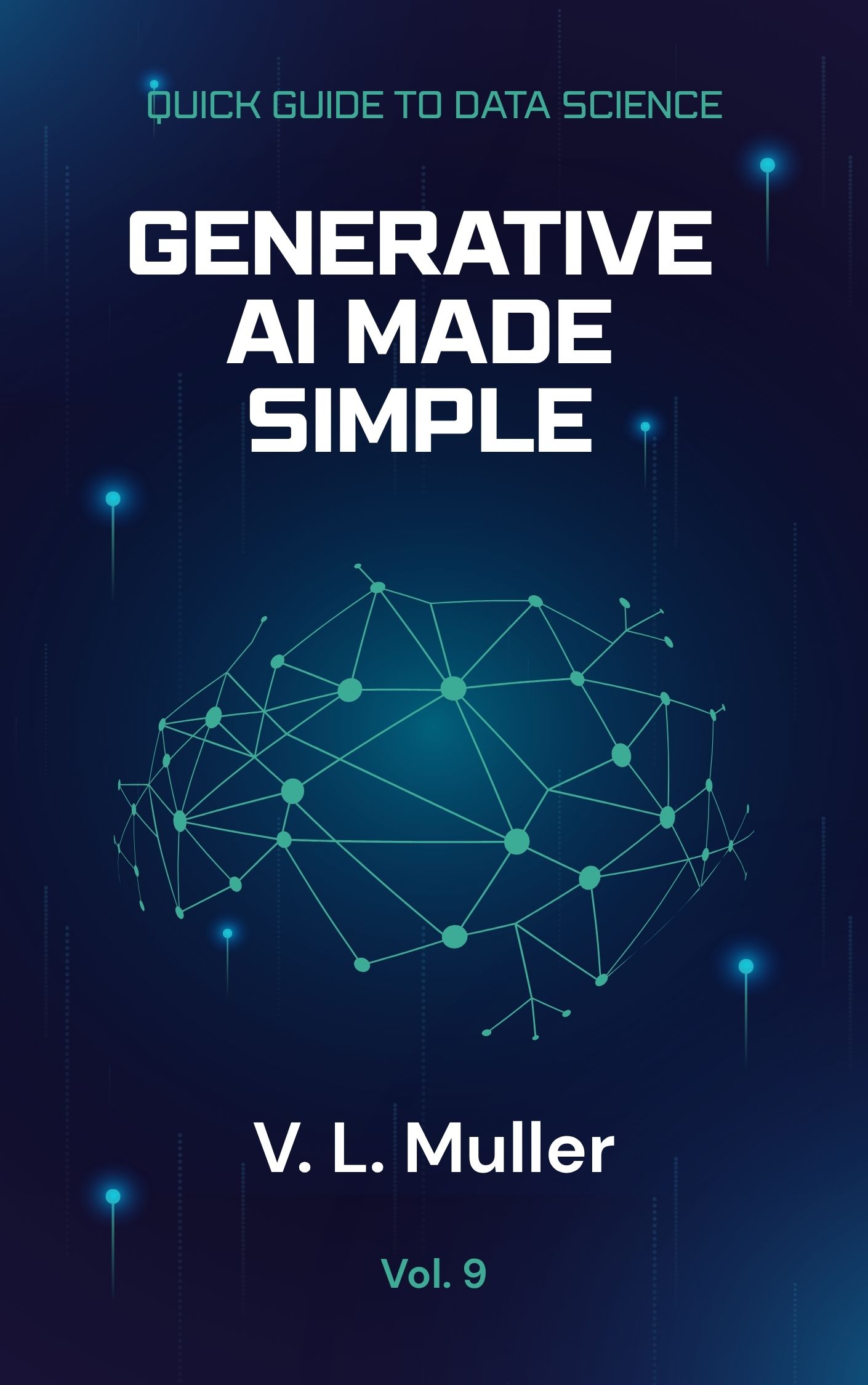
Generative AI Made Simple
by V. L. Muller
In Data Science Quick Guide: Generative AI Made Simple, you will learn, in a clear, practical, and progressive way, how the technology works that is transforming content creation, productivity, and automation across sectors. Ideal for beginners, professionals, managers, students, and curious readers who want to understand the topic without getting lost in the hype, this book explains what generative AI is, how foundation models and LLMs operate, how to use prompts more clearly, what RAG is, where the main areas of value lie, what the risks of hallucinations and biases are, and how to adopt this technology more responsibly—always guided by the 10‑minutes‑a‑day philosophy.
Read guide
NLP Made Simple
by V. L. Muller
In Data Science Quick Guide: NLP Made Simple, you will learn, in a clear, practical, and progressive way, how machines process human language, how text is transformed into mathematical representation, and why NLP has become one of the most important areas of artificial intelligence. Ideal for beginners, students, managers, analysts, and professionals who want to understand the subject without getting lost in excessive technicalities, this book covers concepts such as tokens, vectors, Bag of Words, TF-IDF, embeddings, the attention mechanism, transformers, prompts, text classification, sentiment analysis, named entity recognition, biases, and hallucinations—always guided by the 10-minutes-a-day philosophy.
Read guide
Deep Learning Made Simple
by V. L. Muller
In Quick Guide to Better Data Science: Deep Learning Made Simple, you will understand, in a clear, practical, and progressive way, how deep neural networks work, why they revolutionized artificial intelligence, and where their limits begin. Ideal for beginners, students, analysts, managers, and professionals who want to understand the logic behind Deep Learning without getting lost in excessive technicalities, this book explains concepts such as neural networks, weights, layers, activation, loss function, backpropagation, overfitting, embeddings, transformers, and practical applications in language, computer vision, and recommendation—always following the 10-minutes-a-day philosophy.
Read guide
Data Visualization Made Simple
by V. L. Muller
In Quick Guide to Better Data Science: Data Visualization Made Simple, you will learn, in a practical, clear, and accessible way, how to turn numbers, metrics, and indicators into charts, dashboards, and visual narratives that truly make analysis, communication, and decision-making easier. Ideal for beginners, analysts, managers, BI and Data Science professionals, as well as those in marketing, finance, and operations—and anyone who works with data—this book shows how to choose the right chart, avoid confusing visualizations, structure dashboards intelligently, and use storytelling to communicate insights clearly, always following the 10-minutes-a-day philosophy.
Read guide
Linear Algebra Made Simple
by V. L. Muller
In Quick Guide to Data Science: Linear Algebra Made Simple, you will learn, in a practical, clear, and accessible way, the mathematical foundations that underpin fields such as Data Science, Machine Learning, Deep Learning, Computer Vision, and Artificial Intelligence, understanding how vectors, matrices, the dot product, linear transformations, and linear systems help represent, organize, and transform data in the real world. Ideal for beginners, students, analysts, managers, professionals in career transition, and readers who want to understand the mathematics behind the models without excessive formalism, this book follows the 10 minutes a day philosophy to turn a topic often seen as difficult into an objective, instructive journey connected to practical applications in technology, business, and data analysis.
Read guide
SQL Made Simple
by V. L. Muller
In the Quick Guide to Data Science: SQL Made Simple, you will learn in a practical, clear, and accessible way how to query, filter, organize, summarize, and relate data using SQL, the most important language for working with relational databases in the professional world. This book is designed for beginners, students, analysts, managers, entrepreneurs, and career‑changers who want to understand SQL without excessive technical jargon, building a solid foundation in tables, columns, filters, sorting, aggregate functions, groupings, and JOINs applied to real‑world business, data analysis, and decision‑making scenarios. Following the “10 minutes a day” philosophy, the volume turns a topic often seen as difficult into a straightforward, instructive, and useful path for anyone who wants to gain autonomy in interpreting and exploring data.
Read guide
Python Made Simple
by V. L. Muller
Learning programming doesn't have to be complicated, overly technical, or detached from real life. In The Quick Guide to Data Science: Python Made Simple, you'll discover how to develop a solid foundation in Python in a practical, clear, and accessible way, understanding the essential concepts that underpin programming logic and task automation. Throughout the book, you'll learn about variables, data types, conditions, loops, functions, lists, dictionaries, and simple applications that show how Python can be used to organize information, automate processes, and support analysis in everyday professional life. Ideal for beginners, students, analysts, managers, professionals in career transition, and readers who want to enter the world of programming without intimidation, this volume presents an objective and progressive journey to transform curiosity into practical competence.
Read guide
Statistics Made Simple
by V. L. Muller
Discover how to interpret numbers, charts, averages, probabilities, and comparisons with much greater clarity in Quick Guide to Data Science: Statistics Made Simple. Written in accessible, practical, and straightforward language, this book was designed for those who want to understand the fundamentals of statistics without getting lost in unnecessary technicalities, learning how to apply these concepts in business, sales, marketing, finance, healthcare, education, industry, and real-world decision-making. Throughout the book, you will learn essential topics such as population and sample, mean, median, variability, distribution, probability, correlation, and causation—always accompanied by concrete examples that help turn theory into true understanding. Ideal for beginners, students, professionals in career transition, managers, and curious readers who want to strengthen their analytical foundation and learn to interpret data with greater confidence, maturity, and intelligence.
Read guide
Machine Learning Made Simple
by V. L. Muller
Discover how to enter the world of Artificial Intelligence in a clear, practical, no‑nonsense way with Quick Guide to Data Science: Machine Learning Made Simple. This book was written for anyone who wants to finally understand what Machine Learning is, how it works in practice, and how it can be applied in areas such as business, finance, healthcare, marketing, industry, and technology—even without advanced technical training. In accessible, straightforward, real‑world language, you will learn the fundamentals of machine learning, the main model types, and the importance of data, metrics, and validation, along with concrete application examples that turn theory into true understanding. Ideal for beginners, students, career‑changers, managers, and the simply curious who want to build a solid foundation in Data Science and start small—yet learn for real.
Read guide