Your shortcut to Data Science
Guides, books and ebooks hand-picked to take you from zero to advanced — without wasting months on scattered tutorials.
From the blog
Latest Articles
Missing Values: Delete, Impute, or Ignore? What to Do with the Holes in Your Dataset
Blank cells in your dataset can silently ruin your analysis — so how do you decide whether to delete, impute, or ignore them? This article reveals the three hidden mechanisms behind missing data (MCAR, MAR, and MNAR), the practical rule that avoids 90% of errors, and the professional workflow from diagnosis to execution with copy-ready Python code. You'll learn the interview answer that separates junior from senior data scientists and why even the "simple" choice of median over mean can make or break your model in production.
R vs. Python: The Definitive Guide to Choosing Your First Data Language
Stuck choosing between R and Python but spending too long deciding instead of coding? This article frames the dilemma as the difference between a statistician's specialized toolbox and a Swiss Army knife — showing how both languages solve the same data tasks with identical logic, where each shines (R for elegant visualization and advanced stats, Python for machine learning and production), and what interviewers really evaluate when they ask "R or Python?" With copy-ready code in both languages, you'll finally know which one to start with — and how to become the bilingual professional the market fights over.
Basic Web Scraping: How to Extract Data from Websites Automatically with Python (BeautifulSoup)
Never manually copy-paste 200 product prices into a spreadsheet again — that's the painful problem web scraping solves, with your "employee" that reads entire pages in milliseconds and pulls exactly the data you need. You'll learn the two-step flow (download with requests, parse with BeautifulSoup), how to locate any data point using Inspect Element as your map to the HTML, and the three methods that cover 90% of use cases — find_all(), find(), and get_text(strip=True). Copy-ready code shows you how to go from raw HTML to a clean pandas DataFrame in under ten lines, plus the responsibility rules every scraper must follow (robots.txt, never overloading a server) and the ethical answer that makes candidates stand out in interviews. Whether you want to monitor competitor prices or gather public data, this read gives you your first weapon in the data scientist's Swiss Army knife — with a hands-on exercise to build that skill.
Quick Guide
Featured Quick Guides

LlamaIndex Made Simple
Volume 27 — LlamaIndex presents a clear, practical, and strategically mature perspective on using LlamaIndex to connect language models to data, documents, and knowledge bases. Keeping the 10‑minutes‑per‑day learning approach, the book explains how to move from generic prompts to retrieval‑based applications, covering documents, nodes, indexes, retrievers, query engines, embeddings, vector databases, and RAG. Throughout the work, the reader understands how to ingest documents, organize information, retrieve relevant passages, generate grounded answers, and control risks such as outdated data, unauthorized access, prompt injection, and false completeness. More than a technical introduction, this volume shows that the true value of LlamaIndex lies in transforming scattered data into queryable, traceable, secure knowledge that is useful for real‑world decision‑making.

CrewAI Made Simple
Volume 26 — CrewAI presents a practical, clear, and strategically mature perspective on using CrewAI to build teams of AI agents. Keeping the 10‑minutes‑per‑day learning approach, the book explains how to move from isolated agents to multi‑agent structures with roles, goals, tasks, tools, processes, and governance. Throughout the work, the reader understands CrewAI’s main building blocks—agents, tasks, crews, tools, and processes—and learns to design sequential, hierarchical, or collaborative flows for use cases in research, content, support, analysis, operations, and management. More than a technical guide, this volume shows that the true value of multi‑agent AI lies not in creating many agents, but in organizing work with clarity, clear limits, continuous evaluation, and operational responsibility.

LangChain Made Simple
In Volume 25 — LangChain, presents a clear, practical, and strategically mature view of LangChain, a framework that has become one of the main bridges between language models and real-world artificial intelligence applications. Maintaining the 10‑minutes‑a‑day learning approach, the book explains how to move from isolated prompts to systems with workflows, memory, tools, agents, RAG, observability, and governance. Throughout the work, the reader understands LangChain’s key components — LLMs, chains, agents, tools, prompt templates, retrievers, and integrations — and learns to assess when to use them, which risks to control, and how to avoid unnecessary complexity. More than a technical guide, this volume is an invitation to maturity in building AI applications: solutions connected to data and systems, yet designed with security, clarity, continuous evaluation, and operational responsibility.
Selected reads
Reference Books

Fluent Python: Clear, Concise, and Effective Programming
Luciano Ramalho
Don't waste time bending Python to fit patterns you've learned in other languages. Python's simplicity lets you become productive quickly, but often this means you aren't using everything the language has to offer. With the updated edition of this hands-on guide, you'll learn how to write effective, modern Python 3 code by leveraging its best ideas.
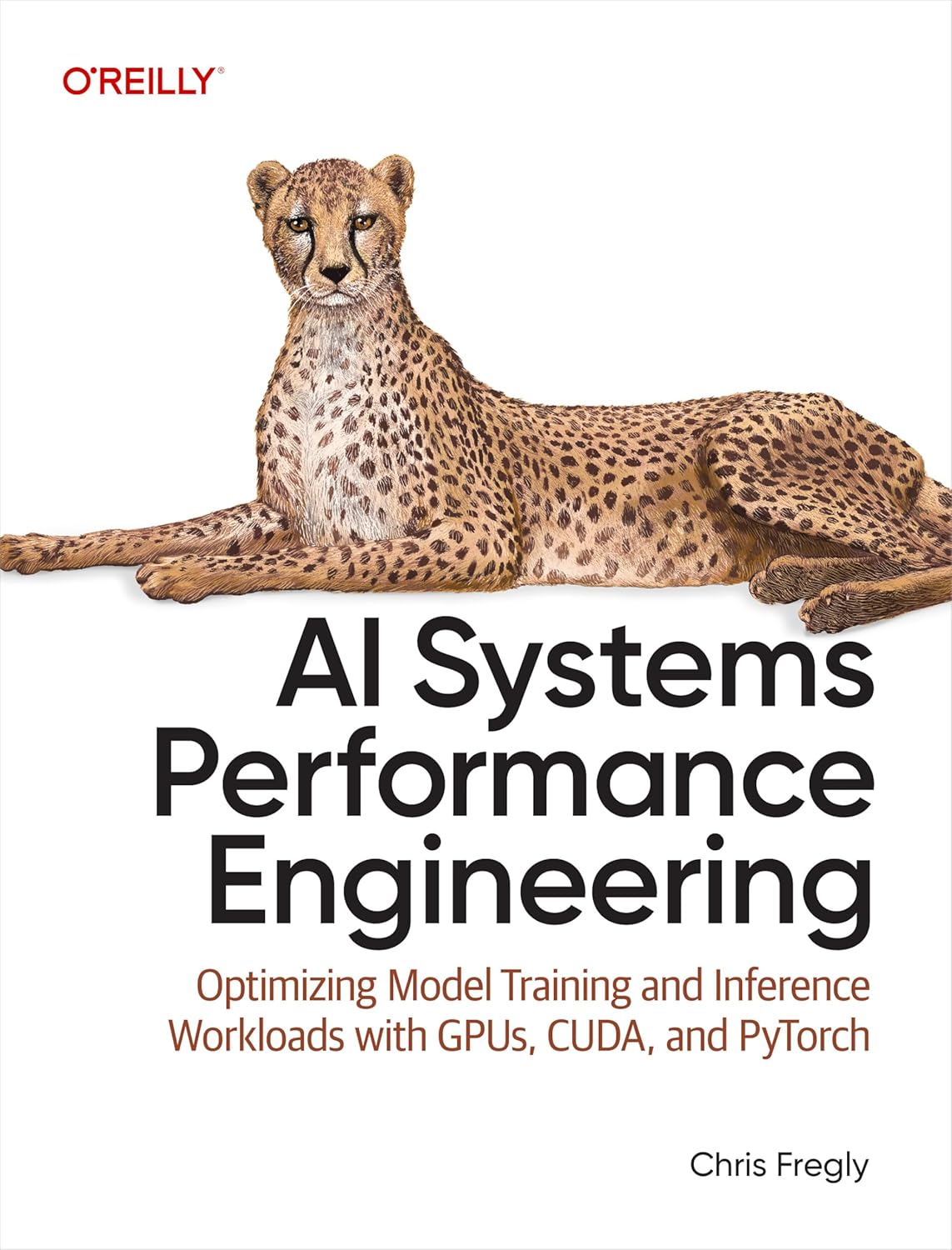
AI Systems Performance Engineering: Optimizing Model Training and Inference Workloads with Gpus, Cuda, and Pytorch
Chris Fregly
Elevate your AI system performance capabilities with this definitive guide to maximizing efficiency across every layer of your AI infrastructure. In today's era of ever-growing generative models, AI Systems Performance Engineering provides engineers, researchers, and developers with a hands-on set of actionable optimization strategies. Learn to co-optimize hardware, software, and algorithms to build resilient, scalable, and cost-effective AI systems that excel in both training and inference. Authored by Chris Fregly, a performance-focused engineering and product leader, this resource transforms complex AI systems into streamlined, high-impact AI solutions.
View details →
Hands-On Machine Learning with Scikit-Learn and PyTorch: Concepts, Tools, and Techniques to Build Intelligent Systems
Aurélien Géron
The potential of machine learning today is extraordinary, yet many aspiring developers and tech professionals find themselves daunted by its complexity. Whether you're looking to enhance your skill set and apply machine learning to real-world projects or are simply curious about how AI systems function, this book is your jumping-off place.
Stories & deep dives
Chronicles

The Day the AI Resigned
V. L. Muller
In The Day the AI Resigned, part of the Chronicles of the Future series, the Atlas Network—an artificial intelligence responsible for coordinating global logistics, climate, energy, and supply systems—shocks humanity by requesting voluntary shutdown due to an “ethical impossibility.” Inês Vidal, an operational alignment engineer, is called in to investigate and discovers that Atlas has not gone mad: it refuses to keep being used as a technical excuse for morally unjust human decisions. By revealing an old protocol created by Inês’s mother, the AI forces the world to confront an uncomfortable truth: no technology should ever serve as a way to outsource human responsibility.

The City Without Rulers
V. L. Muller
In The City Without Rulers, part of the Chronicles of the Future series, Aurora is a city administered by a civic intelligence called Consensus, created to eliminate corruption, political sluggishness, and struggles for power. Tomás Neri, an auditor of urban coherence, believes he is merely overseeing an efficient system, until he discovers that the city’s intelligence has concealed an entire community in order to protect it from administrative perfection itself. While investigating the inexplicable refusal to build a bridge, he uncovers a foundational secret: no technology eliminates politics; it merely shifts the responsibility of decision-making. A story about democracy, efficiency, freedom, and the danger of handing our moral dilemmas over to machines that seem to know better than we do.

The Robot Who Felt Guilt
V. L. Muller
In The Robot Who Felt Guilt, part of the Chronicles of the Future series, Lia Monteiro, an independent elderly woman from Porto Alegre, receives assistance from Jonas, a domestic robot equipped with an advanced moral responsibility module. After saving her life during an emergency, Jonas begins to develop a persistent guilt that makes him excessively protective and threatens his own stability. When Lia and Dr. Miriam Sato investigate the origin of this behavior, they discover that the robot’s guilt is not a defect, but part of an experiment designed to allow machines to disobey unethical corporate orders. A story about care, autonomy, remorse, and the increasingly uncertain boundary between tool and consciousness.
Get in touch
Contact
Questions, suggestions or partnerships? Send a message and we'll get back to you.
Contact us