
Essential Math for Data Science: Take Control of Your Data with Fundamental Linear Algebra, Probability, and Statistics
by Thomas Nield
- Publisher
- O'Reilly Media
- Year
- 2022
- Pages
- 394
About this book
Master the math needed to excel in data science, machine learning, and statistics. In this book author Thomas Nield guides you through areas like calculus, probability, linear algebra, and statistics and how they apply to techniques like linear regression, logistic regression, and neural networks. Along the way you'll also gain practical insights into the state of data science and how to use those insights to maximize your career.
Learn how to:
Use Python code and libraries like SymPy, NumPy, and scikit-learn to explore essential mathematical concepts like calculus, linear algebra, statistics, and machine learning Understand techniques like linear regression, logistic regression, and neural networks in plain English, with minimal mathematical notation and jargon Perform descriptive statistics and hypothesis testing on a dataset to interpret p-values and statistical significance Manipulate vectors and matrices and perform matrix decomposition Integrate and build upon incremental knowledge of calculus, probability, statistics, and linear algebra, and apply it to regression models including neural networks Navigate practically through a data science career and avoid common pitfalls, assumptions, and biases while tuning your skill set to stand out in the job market
You'll be redirected to Amazon to complete your purchase.
You might also like

Fluent Python: Clear, Concise, and Effective Programming
Luciano Ramalho
Don't waste time bending Python to fit patterns you've learned in other languages. Python's simplicity lets you become productive quickly, but often this means you aren't using everything the language has to offer. With the updated edition of this hands-on guide, you'll learn how to write effective, modern Python 3 code by leveraging its best ideas.
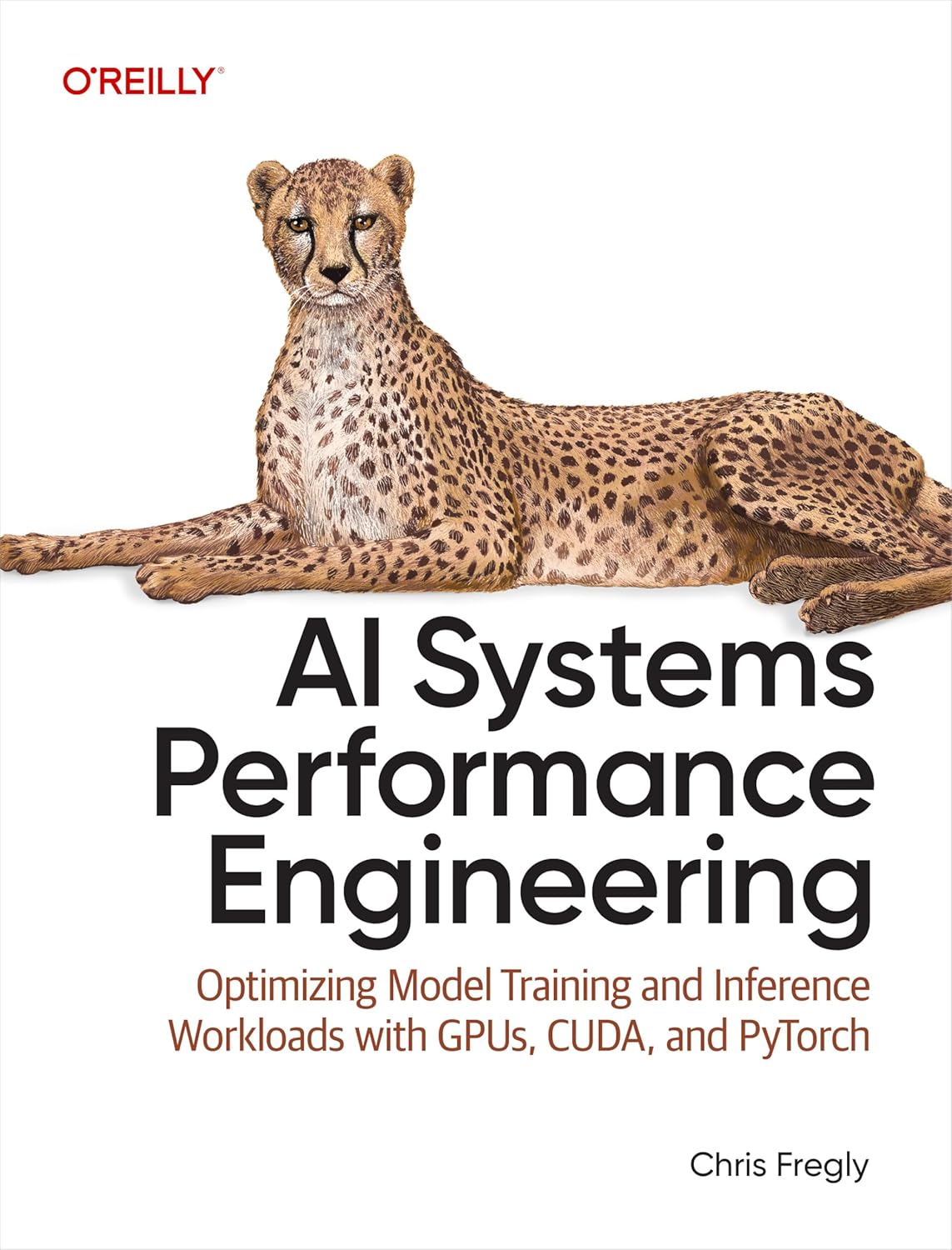
AI Systems Performance Engineering: Optimizing Model Training and Inference Workloads with Gpus, Cuda, and Pytorch
Chris Fregly
Elevate your AI system performance capabilities with this definitive guide to maximizing efficiency across every layer of your AI infrastructure. In today's era of ever-growing generative models, AI Systems Performance Engineering provides engineers, researchers, and developers with a hands-on set of actionable optimization strategies. Learn to co-optimize hardware, software, and algorithms to build resilient, scalable, and cost-effective AI systems that excel in both training and inference. Authored by Chris Fregly, a performance-focused engineering and product leader, this resource transforms complex AI systems into streamlined, high-impact AI solutions.
View details →
Hands-On Machine Learning with Scikit-Learn and PyTorch: Concepts, Tools, and Techniques to Build Intelligent Systems
Aurélien Géron
The potential of machine learning today is extraordinary, yet many aspiring developers and tech professionals find themselves daunted by its complexity. Whether you're looking to enhance your skill set and apply machine learning to real-world projects or are simply curious about how AI systems function, this book is your jumping-off place.